Translation from the original Spanish statement by Espejos del Sur Global, which Stay Grounded signed.
For more than 500 years, the Global North has sought to turn Abya Yala (Latin America) and the Global South into a sacrifice zone for capitalism. First, colonial empires stole gold and silver, extracted at the cost of genocide and the enslavement of indigenous and African peoples.
Then, imperialists and colonialists appropriated the land to create plantations of sugar, cocoa, tobacco, cotton, coffee, and rubber. Later, with nation-states, dependency, and industrialisation, they plundered guano, saltpetre, copper, tin, iron, and coal. In the 20th century, the extraction of fossil fuels, such as oil, began. These resources power the industrial and capitalist machine and have now led us to the worst climate crisis in history.
Also in the 20th century, the United States intervened in Latin American nations and imposed rentier states and dictatorships that served capital and its geopolitical interests. In the 21st century, in addition to fossil extractivism, under the discourse of climate crisis and green transition, extractivism now continues with a ‘green’ label. Today, the precious ‘resources’ are lithium, cobalt, nickel, copper, rare earths, silicon, water and ecosystems converted into carbon sinks, offset markets or ‘nature-based solutions’.
Throughout history, this has been called by different names: evangelisation, civilisation, progress, development. It may be labelled fossil or green, yet it is the same: imperialism. It is the same imperialism that has devastated entire regions of the Middle East to seize control of oil, and which is now once again being unleashed with full force in Abya Yala.
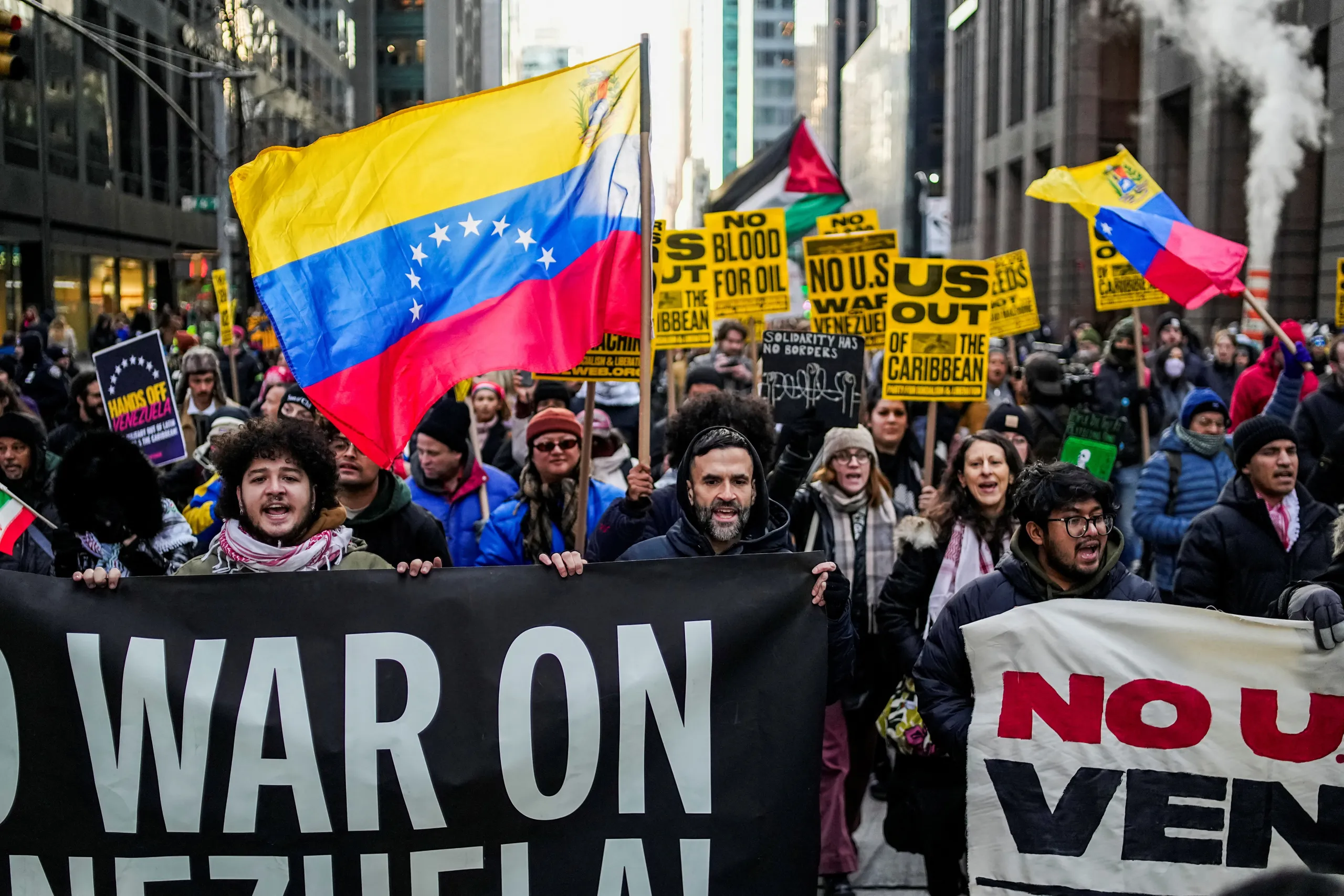
In the early hours of 3 January 2026, the US government intervened militarily in Venezuela, bombing different areas of the capital, Caracas, killing dozens of people and kidnapping then-President Nicolás Maduro and his wife, under the pretext of the ‘war on drugs’. It should be noted that under this excuse, the US government has also killed 115 people on boats in the Caribbean and the Pacific Ocean.
Hours after the intervention, Trump publicly declared:
“They were pumping almost nothing by comparison to what they could have been pumping (…) We’re going to have our great oil companies come in, spend billions of dollars, and start making money (…) We’re going to run the country until we have a proper transition.”
These statements confirmed the obvious: the United States is not intervening for the Venezuelan people, nor for democracy, nor for human rights, nor for climate, nor for life. It is intervening because Venezuela has oil, gas and other ‘strategic resources’, historically treated as plunder.
The same government that has been unable to bring justice to the women who have reported sexual abuse by its current president, Donald Trump; that has allowed Latin American migrants to be criminalised and abused at the hands of ICE; that has carried out bombings in Syria, Iraq, Iran, Somalia, Yemen and Nigeria; and that has supported and financed genocide and apartheid in Palestine, is not and will not be a moral or political authority to intervene in Our America.
The US armed intervention in Venezuela constitutes a flagrant violation of international law, of the principles of non-use of force and self-determination of peoples enshrined in the Charter of the United Nations, and a clear reintroduction of the Monroe Doctrine: the attempt to reaffirm imperial control over the territories, common goods and peoples of Abya Yala.
The gravity of this offensive is not only political or geopolitical: it is also climatic. The IPCC, in its Sixth Assessment Report, states that emissions associated with the fossil fuel infrastructure that already exists in the world are enough to exceed the carbon budget compatible with 1.5 °C, the scientific limit for averting the worst climate impacts.
In this context, reactivating and expanding oil production in Venezuela is openly incompatible with climate science. Venezuela has 303 billion barrels of proven oil reserves, the largest in the world. Burning these reserves would release approximately 131 gigatonnes of CO₂, not counting additional emissions from extraction, refining and transport. This would contribute enormously to global warming, deliberately pushing the planet beyond the limits that enable life as we know it.
Historically, the United States has justified its interventionism by constructing narratives of ‘enemies’: communists, terrorists, migrants or drug traffickers. What is happening today in Venezuela could be replicated throughout Abya Yala. The United States does not act as a saviour, but as a hegemonic power. Its track record in Iraq, Libya and Afghanistan shows that unilateral intervention does not produce democracy, but rather dependence, social fragmentation and systematic human rights violations.
We unequivocally condemn the authoritarianism of Nicolás Maduro’s government, the human rights violations and crimes against humanity committed by the Venezuelan state. We demand the release of all political prisoners and hope that the crimes of the Venezuelan state will not go unpunished. But this condemnation cannot be used to legitimise imperial intervention or a new cycle of plunder.
The Venezuelan crisis will not be resolved by external interference, sanctions, bombings or military occupations. It will be resolved by guaranteeing something much more profound: that no power will ever again dominate and exploit territories, people, ecosystems and energy in the name of progress above the rights of people and nature.
What is happening today between the United States and Venezuela is not a distant conflict: it is a warning sign about the kind of world, and region, that is emerging/we are allowing to emerge. The gravity of the situation without global repercussions is an example for other nations to replicate this imperialist logic in different regions of the Global South.
US imperialism in Venezuela and Abya Yala:
- Reduces territories to resources, turning nature into a commodity, denying that they are home to living peoples, cultures and ecosystems.
- Deepens the environmental crisis, reinforcing an energy model responsible for climate collapse and delaying a just energy transition
- Violates sovereignty, self-determination of peoples and human rights.
- It normalises global inequality, perpetuating a relationship in which the North benefits while the South bears the social and ecological costs.
- It sets dangerous precedents, weakening international human rights standards and opening the door for new social and environmental conflicts.
In a context where seven out of nine planetary boundaries have already been exceeded, fossil imperialism is a direct threat to life on Earth. The environmental crisis is not only ecological, it is political. As long as the territories of the Global South continue to be seen as resource reserves and not as living spaces, the devastation will continue to repeat itself under different names.
Defending life today means stating clearly: no to internal authoritarianism, but also no to fossil imperialism, green imperialism, or imperialism of any kind. Without environmental sovereignty there can be no just transition, and without climate justice there can be no true democracy.
Abya Yala is not a sacrifice zone.
It is a living territory, and it will exercise its right to determine its own destiny. Defending the self-determination of the peoples of the Global South means defending the land, water, ecosystems and common future that is currently under threat.